
Antiscalant or Softener Before RO: Which One Do You Need?
Antiscalant and softeners both protect RO membranes from scale, but in different ways. Learn when each fits, when to use both, and how hardness and recovery decide.
G1 Aqua engineering team
3 min read
RO membranes hold back salts, and the salts in the reject get more concentrated as the water moves through. Calcium and magnesium can then exceed their solubility and form scale on the membrane. Two tools stop this: a softener, which removes hardness before the RO, and an anti-scalant, which keeps the salts in solution. Choosing between them depends on how hard the water is and how hard you push the recovery.
What each one does
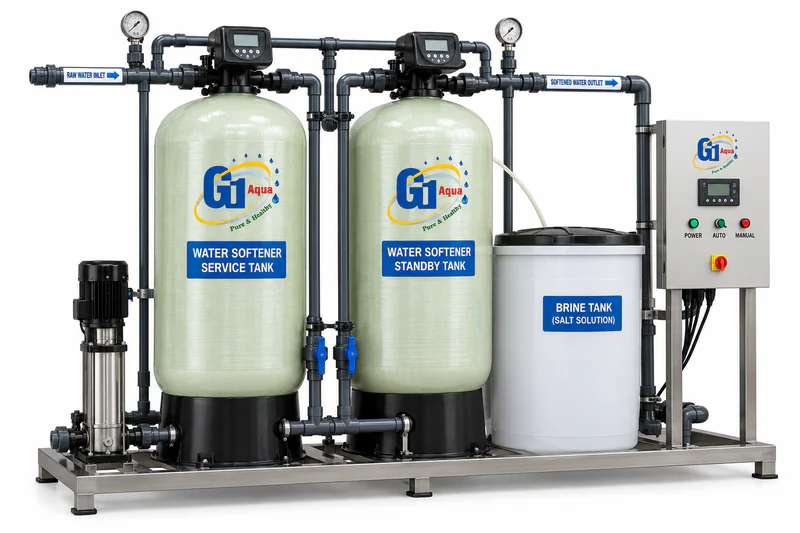
Softener. An ion exchange resin takes calcium and magnesium out of the feed and gives sodium back. The water entering the RO is almost free of hardness, so it cannot scale with calcium carbonate or sulphate. The resin must be regenerated with salt. See water softening plants.
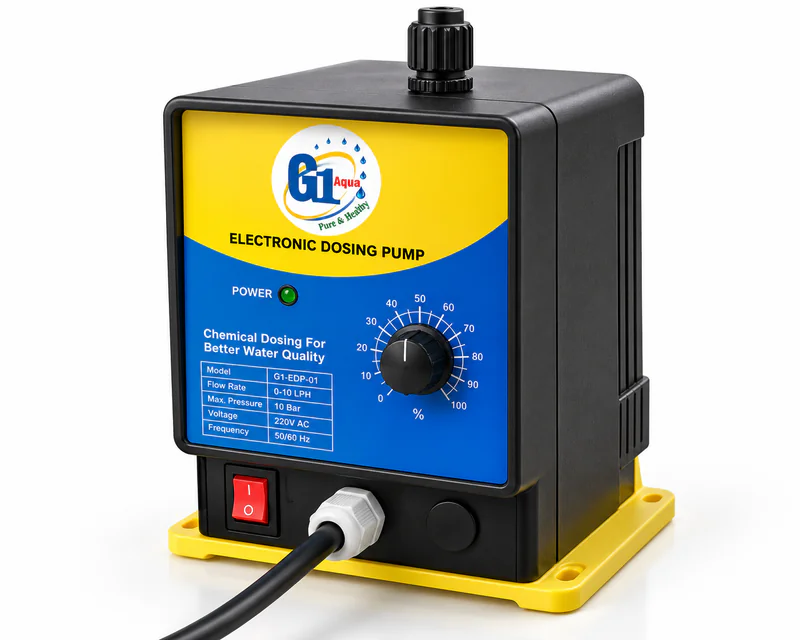
Anti-scalant. A small dose of a chemical is pumped into the feed. It interferes with crystals as they form, so they stay in the reject instead of sticking to the membrane. It does not remove hardness. See anti-scalant chemicals and the dosing pump that feeds it.
How to decide
| Situation | Usual choice |
|---|---|
| Hardness low to moderate, normal recovery | Anti-scalant alone |
| Hardness high, recovery high | Softener, sometimes with anti-scalant too |
| Very hard water with silica or iron | Pre-filtration first, then softener, and a careful design |
| Small plant, little operator time | Anti-scalant is simpler. A softener adds salt handling and regeneration |
| Reject must be reused or kept low in sodium | Anti-scalant, since a softener adds sodium |
A rough guide is that anti-scalant can handle a good deal of hardness at ordinary recovery, but the right limit depends on the water chemistry and the product. Ask the supplier to run a projection with your water report. See how to read a water test report.
Why recovery matters
At 75% recovery the reject is concentrated about four times, against 2.5 times at 60%. A water that is safe at 60% can scale at 75%. This is also why raising recovery to save reject water needs more protection. See RO reject water.
Using both
Plants with hard water and high recovery often use a softener and a small anti-scalant dose. The softener does the heavy work, and the anti-scalant covers upsets such as a resin that is exhausted late or a spike in hardness.
What neither one fixes
Neither handles iron, silt, chlorine or biological growth. Those need filters, carbon and cartridges ahead of the RO. See water softener versus RO for how the two systems differ, and the RO maintenance checklist for how to catch scale early.
If you are unsure which pre-treatment fits, send us a water report. Use the contact page.
Know someone with the same problem? Send them this guide.
Products in this guide
Is this your problem?
Send a photo or your water report. An engineer will tell you what fits.
Ask on WhatsApp