
Methods to Soften Hard Water: Ion Exchange and Alternatives
Hard water destroys plumbing. We explore the most effective ways to treat it, from traditional Ion Exchange Water Softeners to Lime Softening and modern Chelating agents.
G1 Aqua engineering team
4 min read
Combating hard water is a billion-dollar industry. While there are many "magic magnets" and gadgets sold online, the chemistry of real water softening is well-established.
Here are the proven methods to soften hard water.
1. Ion Exchange (The Gold Standard)
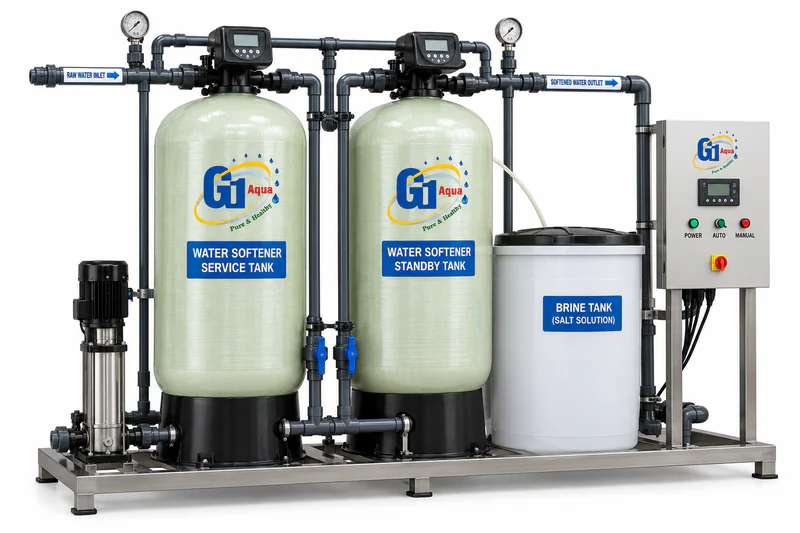
This is the technology used in 99% of residential and commercial water softeners.
- How it Works: The softener tank is filled with small plastic beads called Resin. These beads are charged with Sodium (Na+) ions.
- The Exchange: As hard water flows over the resin, the resin prefers Calcium (Ca2+) and Magnesium (Mg2+) more than Sodium. It grabs the hardness minerals and releases the Sodium into the water.
- Regeneration: Eventually, the resin is full of Calcium. The system flushes itself with a strong Salt Brine (NaCl) solution, forcing the Calcium off and recharging the beads with Sodium.
- Pros: Truly removes hardness; water feels silky; saves appliances.
- Cons: Adds sodium to water; requires buying salt bags; wastes regeneration water.
2. Lime Softening (The Industrial Giant)
Used primarily by municipal water treatment plants (not for homes).
- How it Works: Adding Lime (Ca(OH)2) and Soda Ash (Na2CO3) to the water raises the pH.
- The Reaction: At high pH, Calcium and Magnesium become insoluble and precipitate out as solids (sludge).
- Pros: Economical for massive volumes; also reduces bacteria and turbidity.
- Cons: Creates massive amounts of chemical sludge; requires precise chemical control and filtration.
3. Chelation (The Detergent Helper)
Used in laundry detergents and specialized cleaning products.
- How it Works: Chelating agents (like EDTA or Citric Acid) are chemicals that wrap around the Calcium ion like a claw.
- The Result: The Calcium is still in the water, but it is "sequestered" (hidden). It cannot react with soap to form scum.
- Pros: Good for cleaning applications.
- Cons: Not practical for whole-house treatment; chemicals are expensive.
The Chemistry of Success: Ion Exchange
Inside a softener, a silent chemical swap is happening billions of times every second. The resin beads are like a nightclub that only has room for Divalent ions (Ca2+, Mg2+).
Resin-Na₂ + Ca²⁺ → Resin-Ca + 2Na⁺- Calcium is "trapped" on the resin.
- Sodium is "released" into your water.
Comparison of Softening Technologies
| Feature | Ion Exchange (Salt) | Reverse Osmosis (RO) | TAC (Salt-Free) | Distillation |
|---|---|---|---|---|
| Actually Removes Minerals? | Yes | Yes | No (Changes form) | Yes |
| Soft Water Feel | High | Moderate | None | Moderate |
| Energy Required | Very Low | Moderate | None | High |
| Water Waste | High (Backwash) | Highest (Reject) | Zero | Low |
| Best For | Whole House | Drinking Only | Scale Prevention | Lab Use |
The "Salt-Free" Controversy (TAC)
Many companies sell Template Assisted Crystallization (TAC) as a "Salt-Free Softener."
- How it works: Tiny polymer beads convert dissolved calcium into microscopic crystals.
- The Reality: The calcium is still in the water. If you test the water, it will still show as "Hard."
- The Performance: It works perfectly for preventing scale in pipes and water heaters, but it will not help with soap lathering or dry skin. It is a "Physical Conditioner," not a "Chemical Softener."
Operational Best Practices
To keep a water softener running for 15+ years:
- Salt Bridge Prevention: Don't fill the salt tank to the very top. High humidity can cause salt to form a "crust" across the top, preventing the brine from reaching the water below.
- Iron Out: If you have well water with iron, add a Resin Cleaner to your salt tank monthly. Iron "stains" the resin and reduces its capacity to soften.
- Softener Bypass: If you are watering your lawn or filling a swimming pool, use the Bypass Valve. Gardening with softened water is a waste of salt and can harm plants due to the high sodium content.
Which One Should You Choose?
- For Silky Skin/Hair: Ion Exchange is the only real choice.
- For Low Maintenance Appliance Protection: TAC (Salt-Free) is ideal.
- For Drinking Water Purity: Reverse Osmosis.
Questions people ask
Know someone with the same problem? Send them this guide.
Products in this guide
Is this your problem?
Send a photo or your water report. An engineer will tell you what fits.
Ask on WhatsApp